Parking below, park above
For half a century the filled-in docks of Antwerp's Zuid district were the city's biggest free car park. Now about 2,000 cars park underneath, and a park of 7–8 hectares grows on top.

- Size
- ≈ 7–8 ha
- Built
- Dec 2020 – May 2024
- Cost
- ≈ €32 M
- Decision to finish
- 9 yr
Zuidpark is one of the finalists for the European Prize for Urban Public Space. The winner is announced on 15 October.
Before
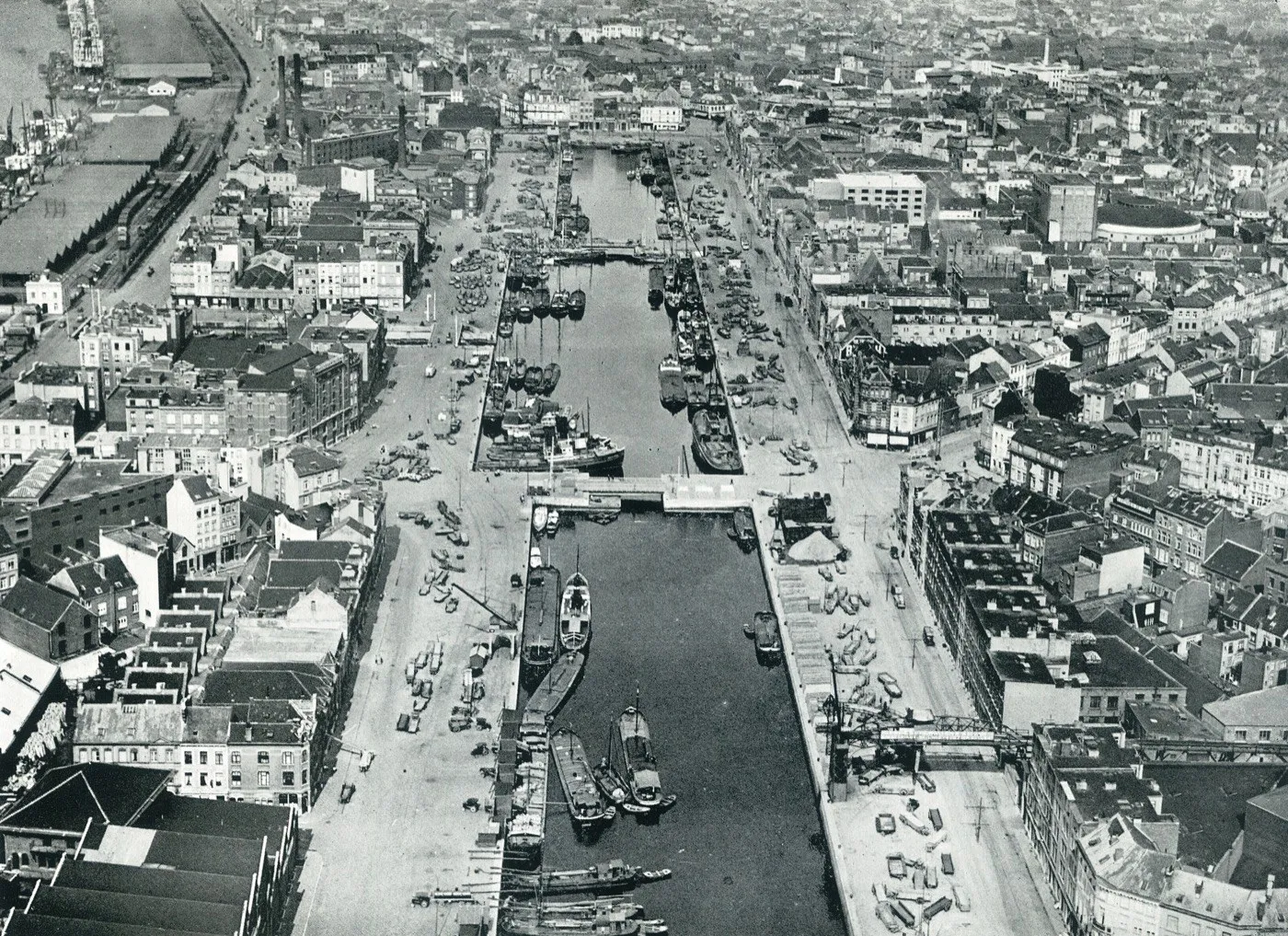
In the 19th century, three docks were dug in Antwerp’s Zuid district. They were filled in around 1969. For the next half-century the site was “largely used as a free car park”, and the city later called it “de facto the largest free car park in the city”. Once a year, the Sinksenfoor funfair moved in.
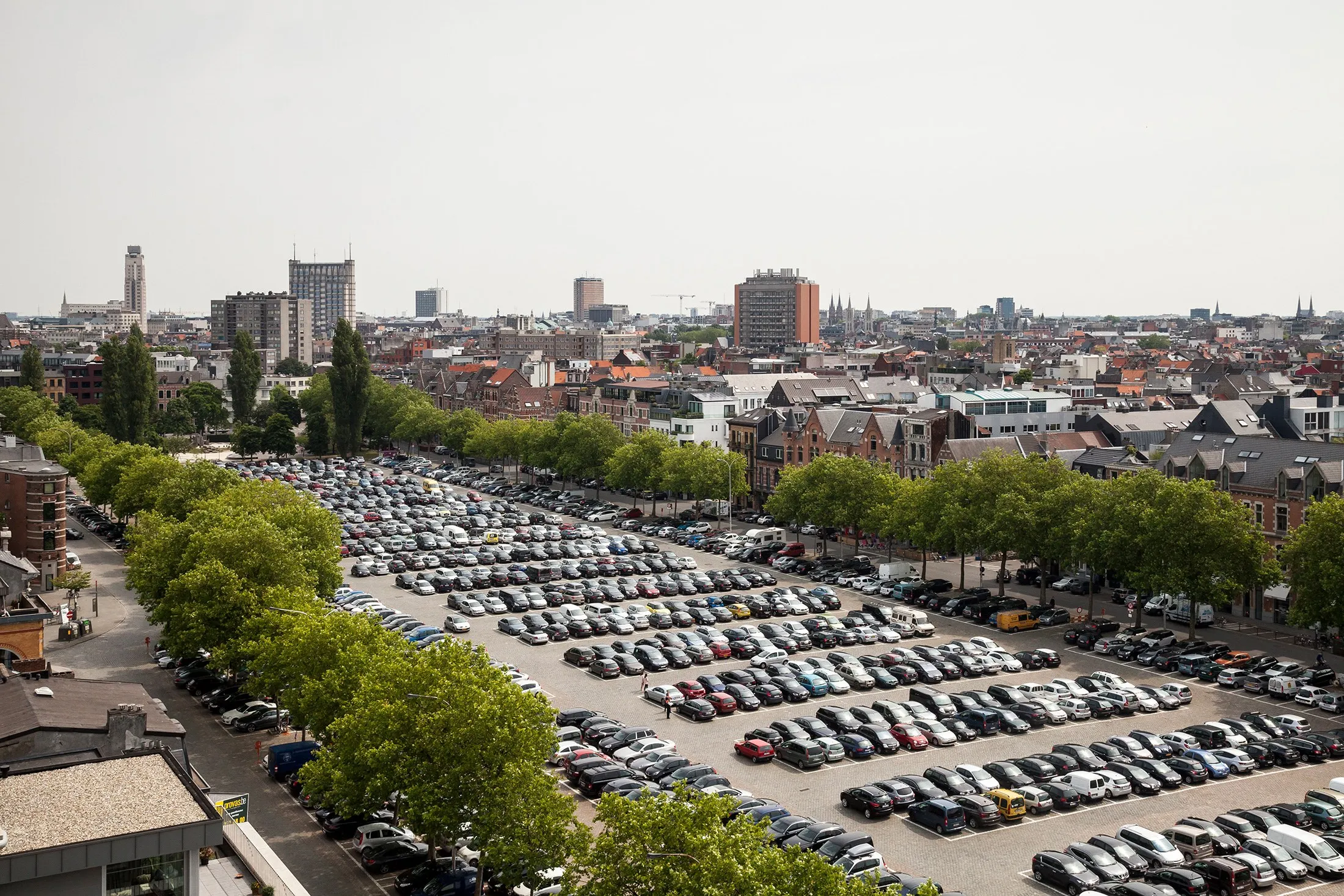
The change started with neighbours. In 2012, six residents went to court. Their lawyer argued that under the regional zoning plan “the big car park on the Gedempte Zuiderdokken was supposed to be a park” (VRT). The fair left in 2015. That year the city asked residents what they wanted instead. Their top answers: green space and water.
After
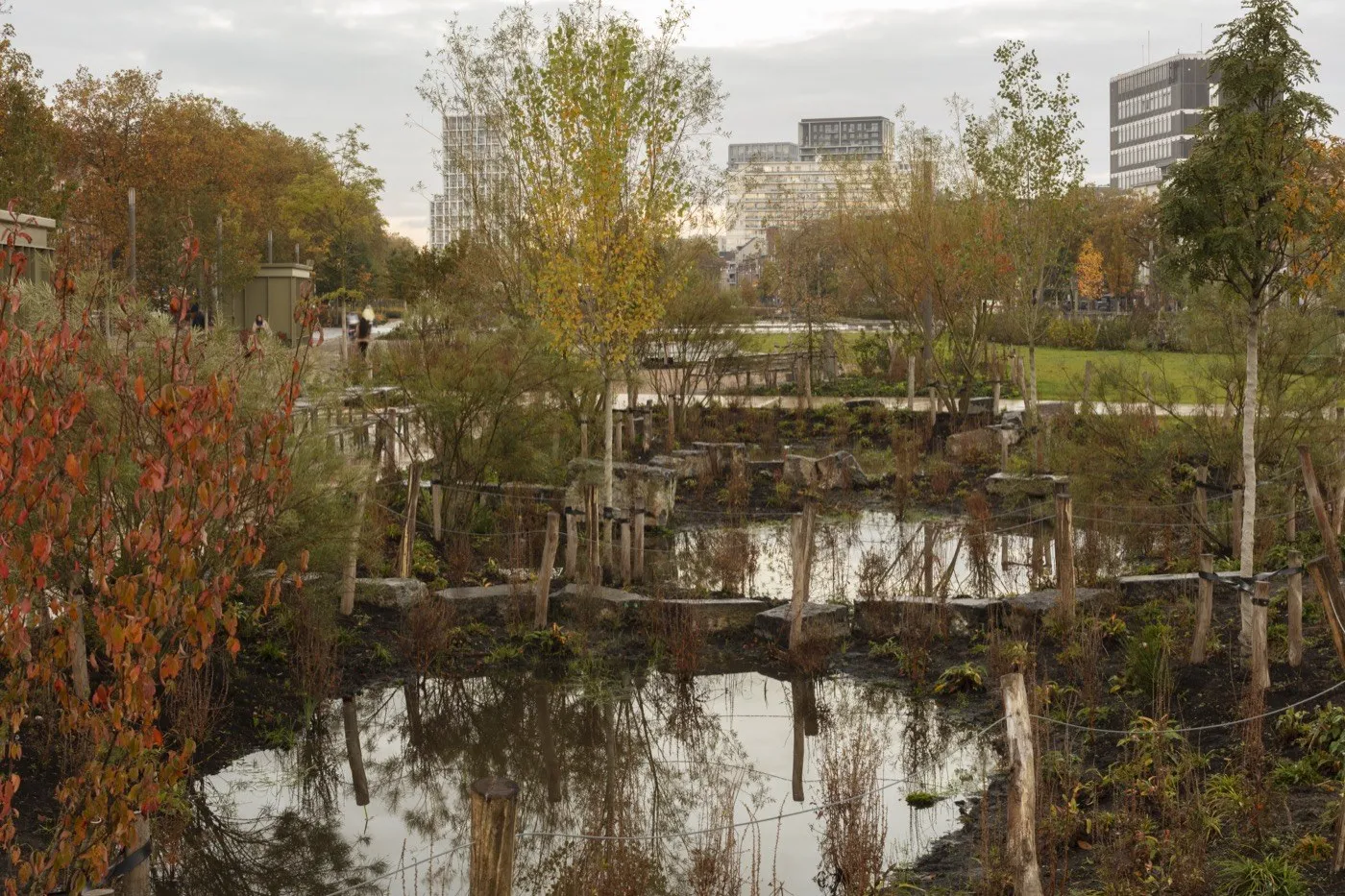
The cars didn’t disappear. They went underneath. Two garages were built inside the outlines of the old docks: Steendok, with 900 spaces, opened in December 2020, and Kooldok, with 1,094. On top, under a deep layer of soil, a park of about 7–8 hectares (city and designers give slightly different figures):
- 508 new trees
- 13,500 m² of grass and 9,000 m² of shrubs and perennials
- a 1,500 m³ tank that stores rainwater from nearby roofs, and a 7,000 m³ layer of clay pebbles under the central meadow that soaks up storms
- three playgrounds, a play fountain and a dog park, plus a community garden and a sports field

 2009 2024
 Who made it happen
The City of Antwerp, through its development company AG Vespa, with water utility Water-link. The design team won a 2015 competition run with the Flemish government’s architect, the Vlaams Bouwmeester: Belgian engineers Tractebel, French studio ADR and Swiss landscape architect Georges Descombes, with Erik De Waele on planting and LEA on lighting. And six stubborn residents.
Cost and time
The reported cost grew as the scope grew. The 2015 competition set a €16.2M construction budget. By 2022 it was €25M, including €2.3M from the EU, and by 2023 about €32M for the whole redevelopment. No final cost has been published. The garages are run under a concession by Q-Park, which recovers its building costs from parking fees.
The park opened in three phases: May 2022, June 2023 and May 2024.
Did it work?
It’s cooler, and it should get cooler still. University of Antwerp researchers combined field measurements with a 3D climate model. They simulated the old car park and the new park on the hottest day of 2024:
- Today: the air is on average 0.6 °C cooler than over the car park, and at the hottest moments it feels 1.2 °C cooler. Under the trees it feels up to 10 °C cooler.
- Once the trees mature: it should feel 4.6 °C cooler on average, and up to 18 °C cooler under the canopy.
These are model results using one hot day’s weather, not before-and-after readings. The car park no longer exists to measure.
The juries like it. It won Flanders’ Prijs Publieke Ruimte 2025 and its public vote and the Green Cities Europe Award 2025.
The honest caveat. In its first year the central lawn flooded after heavy rain because the soil had been compacted. The city tried aerating it and adding lava stones; in May 2024 the problem was still there. We couldn’t find whether it’s fixed now. No visitor counts, biodiversity surveys or measured water figures have been published.
What others can copy
- Parking below, park above. Antwerp didn't make it park versus parking. It moved about 2,000 spaces underground, with a private operator carrying the garage costs, and freed the surface.
- Build the park as a sponge. Rain tanks, a storage layer under the lawn and planted basins turn a park into flood protection. Protect the soil while you build: compacted ground undid the lawn in year one.
- Plant for the long game, then measure. The cooling is modest today and big once 508 trees grow up. Measure the "before" while you still can: Antwerp's researchers had to model the car park.
Sources8 links · every number above is linked too
- Vlaams Bouwmeester: Antwerpen Zuiderdokken
- Landezine: Zuidpark by Tractebel
- University of Antwerp: Zuidpark temperature study
- VRT: last part of Zuidpark opens (May 2024)
- VRT: ten years since the Sinksenfoor left
- City of Antwerp: Steendok car park opens
- Q-Park: Kooldok car park
- VRT: Zuidpark wins the Prijs Publieke Ruimte
Spotted a mistake? Tell us and we'll correct this page and say so.